
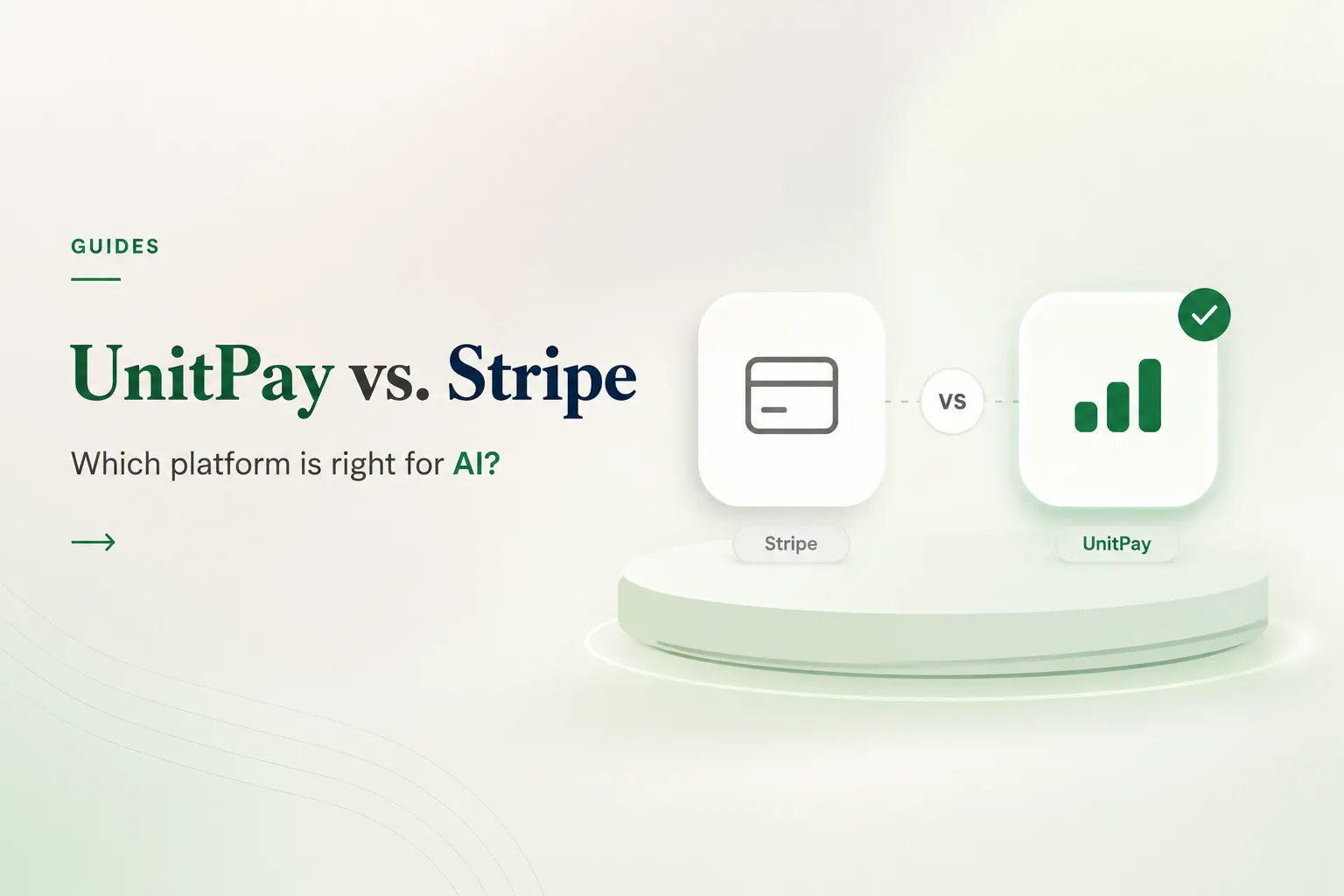
When founders think about billing, Stripe is often the first name that comes to mind. Stripe powers payments for millions of companies with a mature platform for subscriptions, invoicing, and checkout. But AI companies—especially those building agentic products—face a very different challenge: how do you monetize complex, variable-cost workflows like tokens, embeddings, calls to APIs, and outcome-based results?
This is where UnitPay enters the picture. Purpose-built for AI agents, UnitPay provides the billing infrastructure that captures value where Stripe leaves off.
Stripe: Great for Payments, Limited for AI Monetization
Stripe is a payments giant, optimized for:
- Payment processing (credit cards, ACH, wallets)
- Subscriptions and invoices for SaaS
- Tax and compliance (Stripe Tax, Atlas, etc.)
- Marketplace payouts
Where Stripe falls short for AI companies:
- No AI-native pricing models. Stripe supports seats, tiers, and usage, but not tokens, embeddings, or outcome-based billing.
- No cost attribution. Stripe doesn’t track your LLM, compute, or API costs against each customer.
- Engineering overhead. Implementing complex AI pricing requires custom middleware and spreadsheets.
- No ROI visibility. Stripe can’t help you prove customer ROI—critical in AI sales.
UnitPay: Built as the Revenue Engine for AI Agents
UnitPay focuses specifically on AI-native monetization. With ~10 lines of code, founders can plug in UnitPay’s SDK and unlock:
- Flexible AI pricing – Usage, outcome-based (e.g. per hire, % of deal closed), hybrid, or platform fees.
- Granular cost tracking – Allocate true costs across LLMs, TTS/STT, APIs, compute, vector DBs—per agent, per customer.
- Profitability dashboards – See margins by customer, feature, or agent in real time.
- Price simulation & versioning – Run “what if” scenarios before rolling out pricing changes.
- Automated invoicing – Generate invoices that combine subscriptions with variable agent activity.
- ROI reports for customers – Show exactly how your AI saves money or drives revenue.
Side-by-Side Comparison
| Feature | Stripe | UnitPay |
|---|---|---|
| Core Focus | Payments & SaaS subscriptions | AI-native monetization & margin tracking |
| Pricing Models | Seats, tiers, usage | Usage, outcome, hybrid, platform fee |
| AI Cost Tracking | Not supported | Full-stack (LLM, API, compute, vector DB) |
| ROI Analytics | Not available | Automated ROI dashboards for customers |
| Pricing Experiments | Manual (custom code) | No-code simulations & versioning |
| Invoicing | Robust | AI-aware (variable + subscription combined) |
| Integration Effort | High for AI | 10-line SDK |
When to Use Each
- Stripe alone: If you’re running a traditional SaaS business with predictable pricing and minimal AI stack costs.
- UnitPay + Stripe: If you’re building AI agents or GenAI workflows with complex, variable costs—and want to monetize sustainably, prove ROI, and protect margins.
Final Word
Stripe is the backbone of internet payments. But billing ≠ monetization. For AI companies, Stripe alone leaves gaps—leading to undercharging, hidden costs, and unproven value.
UnitPay exists to fill that gap. As the Revenue Engine for AI agents, it ensures every token, call, and outcome is monetized with precision—and every customer sees the ROI.